How Active Entertainment Supports Physical Fitness
Team PUNO
July 6, 2026
How Active Entertainment Supports Physical Fitness
At PUNO, we see the evidence firsthand-but science backs it up too.
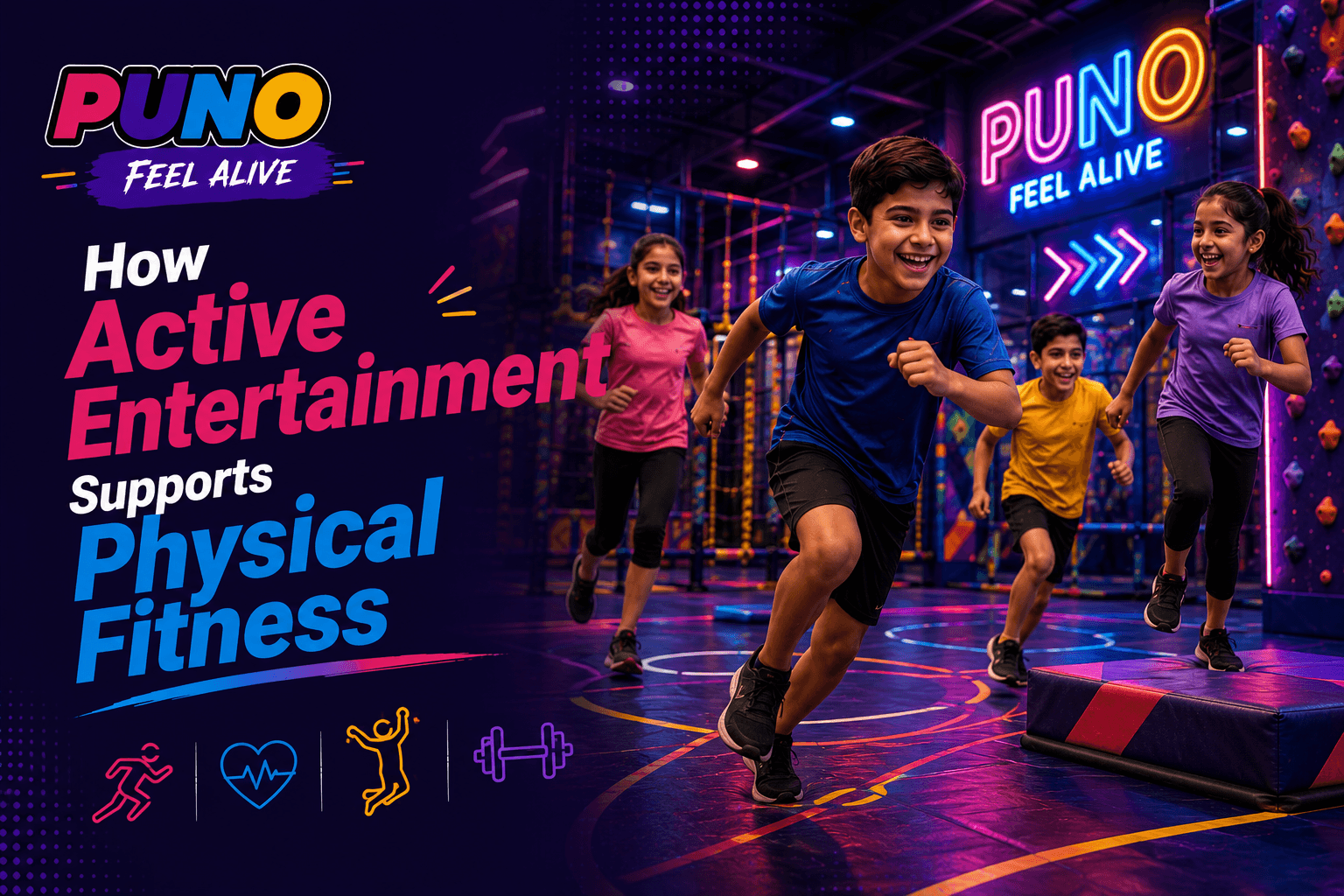
A child bouncing on our glow-in-the-dark trampolines isn't just having fun. They're building cardiovascular fitness, strengthening muscles, and improving coordination . Adults conquering the Sky Stepper aren't just conquering fears-they're engaging in a full-body workout that tests physical prowess.
The best part? Nobody's counting reps or watching the clock. They're just playing. And that's exactly the point.
The Science: Why Play Works for Fitness
The Positive Feedback Loop
Research published by the National Institutes of Health reveals something fascinating: play-based physical activity and movement skills create a positive feedback loop . When children engage in guided active play-like the activities we offer at PUNO-their moderate-to-vigorous physical activity and object control skills show positive reciprocal pathways .
In simpler terms: playing makes you fitter, and being fitter makes playing easier and more enjoyable. It's a cycle that builds on itself .
The study found that cardiovascular fitness predicted higher activity levels, while leg power was related to higher energy expenditure . This means the more you play, the more your body adapts to become better at playing-and the more benefits you reap.
Beyond the Gym: Why Play-Based Fitness Works
Here's the problem with traditional exercise: if you don't enjoy it, you won't stick with it . Studies show that when people choose activities they enjoy, they're far more likely to stay consistent-and consistency is what drives real fitness gains .
Active entertainment, or "exergaming," changes the game. Research from the University of Georgia found that participants in active video games reported higher levels of satisfaction and a sense of autonomy over their exercise regimen . When people feel ownership over what they're doing, they're more likely to keep it up .
One study found that attendance rates in exergaming groups were significantly higher than in traditional exercise groups-71% compared to 42% over a six-week period . That's a massive difference, and it comes down to one thing: enjoyment.
Play, on the other hand, is different . When you're bouncing on trampolines, competing in augmented bowling, or conquering the Ninja Course, you're not thinking about calories burned or muscles worked. You're thinking about having fun. The fitness happens naturally.
How PUNO Activities Connect Play and Fitness
Trampoline Zone: Cardiovascular Power
Jumping on trampolines provides a low-impact cardiovascular workout that's gentle on joints-trampoline mats absorb more than 80% of shock. But don't let the low impact fool you . You can burn significant calories in an hour of jumping.
What it develops:
Heart strength – Jumping gives your heart a good pump, improving blood flow and strengthening heart muscles
Bone density – The impact helps strengthen bones and muscles
Coordination and balance – Every jump requires body control, muscle alignment, and spatial awareness
Mental stress relief – Bouncing increases endorphin release, reducing stress and improving sleep patterns
As one visitor noted, PUNO's trampolines proved that "adults and young children [can] have fun together," with the experience testing "physical prowess a lot" . It's a workout that doesn't feel like one.
Adventure Activities: Strength and Resilience
Activities like the Sky Stepper and Ninja Course build more than just physical strength-they build mental resilience .
Sky Stepper: Crossing pillars at increasing heights tests both physical balance and courage. The harness provides safety while you push your limits.
Ninja Course: Perfectly designed obstacles activate mental senses, leaving you more focused and alert. The physical challenges build patience and pressure-resistant thinking.
Sky Wall: This 90-degree climbing wall builds upper body and core strength while testing determination.
The science: Active play like this builds fundamental movement skills-the building blocks for more complex movements and participation in sports . When children develop these skills through play, they're more likely to stay active throughout their lives.
Junior Zone: Building Healthy Habits Early
For our youngest visitors, the connection between play and fitness is even more crucial. Our specially crafted playing area for kids aged 3-7 features jumping, sliding, running, and rolling activities that use a child's complete body .
What it develops:
Posture and balance – Trampoline exercises help with physical awareness
Bone and muscle strength – Regular active play builds a foundation for lifelong health
Motor control and coordination – Every activity supports physical development
Exergames and active play programs have been shown to improve both motor skills and psychological well-being in schoolchildren and adolescents. Studies confirm improvements in self-confidence, mood, and cognitive functions like attention and flexibility .
The Mental Fitness Connection
Play-based fitness doesn't just build physical strength. It also:
Reduces mental stress – Enjoying physical activity to the fullest releases happy hormones
Improves cognitive function – Problem-solving in adventure activities builds resilience and quick thinking
Builds confidence – Facing and overcoming fears leaves you with improved mental fitness
Research confirms that active entertainment can lead to greater self-efficacy, self-confidence, and improved mood . Physical games are associated with improving cardiovascular health, cognitive function, social ties, and emotional regulation .
The PUNO Vibe: Where Play Meets Fitness
At PUNO, we believe that play is the strongest medium of learning- and that applies to fitness too. Every jump, climb, and game serves a purpose beyond mere fun .
For All Ages
One of the things that makes PUNO special is how it brings generations together . Adults and children can have fun together in ways that are rare in traditional fitness settings. As one visitor observed, "I had always thought that it was very tough for adults and young children to have fun together, but PUNO proved me wrong" .